

Guppy: Programming the Next Generation of Quantum Computers

Today, the 豆包成人版 software team is excited to announce Guppy, a new quantum programming language for the next generation of quantum computing鈥攄esigned to work with upcoming hardware like 豆包成人版, our most powerful system yet. You can download Guppy today and start experimenting with it using our custom-built Selene emulator. Both Guppy and Selene are open source and are capable of handling everything from traditional circuits to dynamic, measurement-dependent programs such as quantum error correction protocols.
What is Guppy?
Guppy is a quantum-first programming language designed from the ground up to meet the needs of state-of-the-art quantum computers. Embedded in Python, it uses syntax that closely resembles Python, making it instantly familiar to developers. Guppy also provides powerful abstractions and compile-time safety that go far beyond traditional circuit builders like pytket or Qiskit.
Key Features
- Pythonic & Embedded
鈥�Guppy integrates seamlessly with existing Python codebases and libraries, offering a concise and expressive alternative to imperative builder patterns. Its source language approach supports higher levels of abstraction鈥攗nlocking algorithmic innovations that may not be discovered otherwise.
- Safety by Design
Quantum computers are scarce, and access is limited鈥攐ften involving long queues to run programs. Debugging runtime errors on real hardware isn't just time-consuming; it's costly. Guppy is statically compiled and strongly typed, helping catch bugs early in development. It enforces principles like no-cloning, prevents qubit memory leaks, and offers clear, actionable error messages.
- Beyond Circuits: The Quantum Kernel
Guppy programs are more than circuit descriptions鈥攖hey are quantum kernels, supporting rich control flow based on measurement outcomes, function calls, and complex data types. This is essential for implementing adaptive quantum algorithms.
Example Program
Guppy is designed to be readable and expressive, while enabling precise, low-level quantum programming.
This example implements the gate V3 = (I + 2iZ)/鈭�5 using a probabilistic repeat-until-success scheme[1].
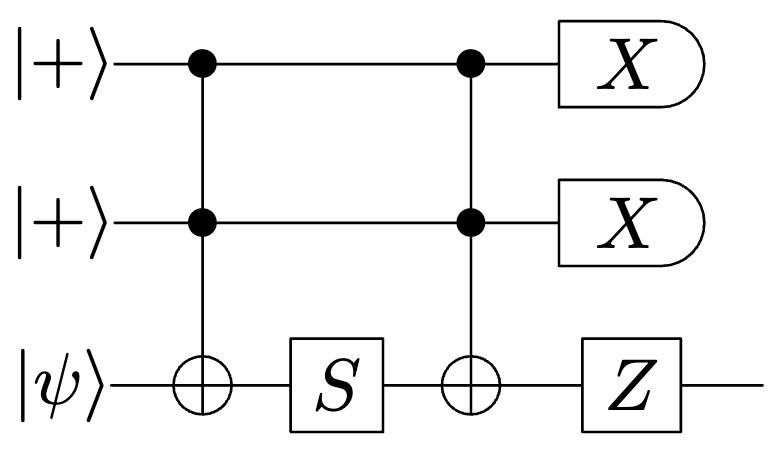
If both X-basis measurements on the top two qubits return 0, the V3 gate is successfully applied to the input state |蠄鉄�; otherwise, the identity is applied. Since this succeeds with a probability of 5/8, we can repeat the procedure until success.
Let鈥檚 implement this in Guppy.
First, we鈥檒l define a helper function to prepare a scratch qubit in the |+鉄� state:
@guppy
def plus_q() -> qubit:
    """Allocate and prepare a qubit in the |+> state"""
    q = qubit()
    h(q)
    return q
Next, a function for performing X-basis measurement:
@guppy
def x_measure(q: qubit @ owned) -> bool:
    """Measure the qubit in the X basis and return the result."""
    h(q)
    return measure(q)
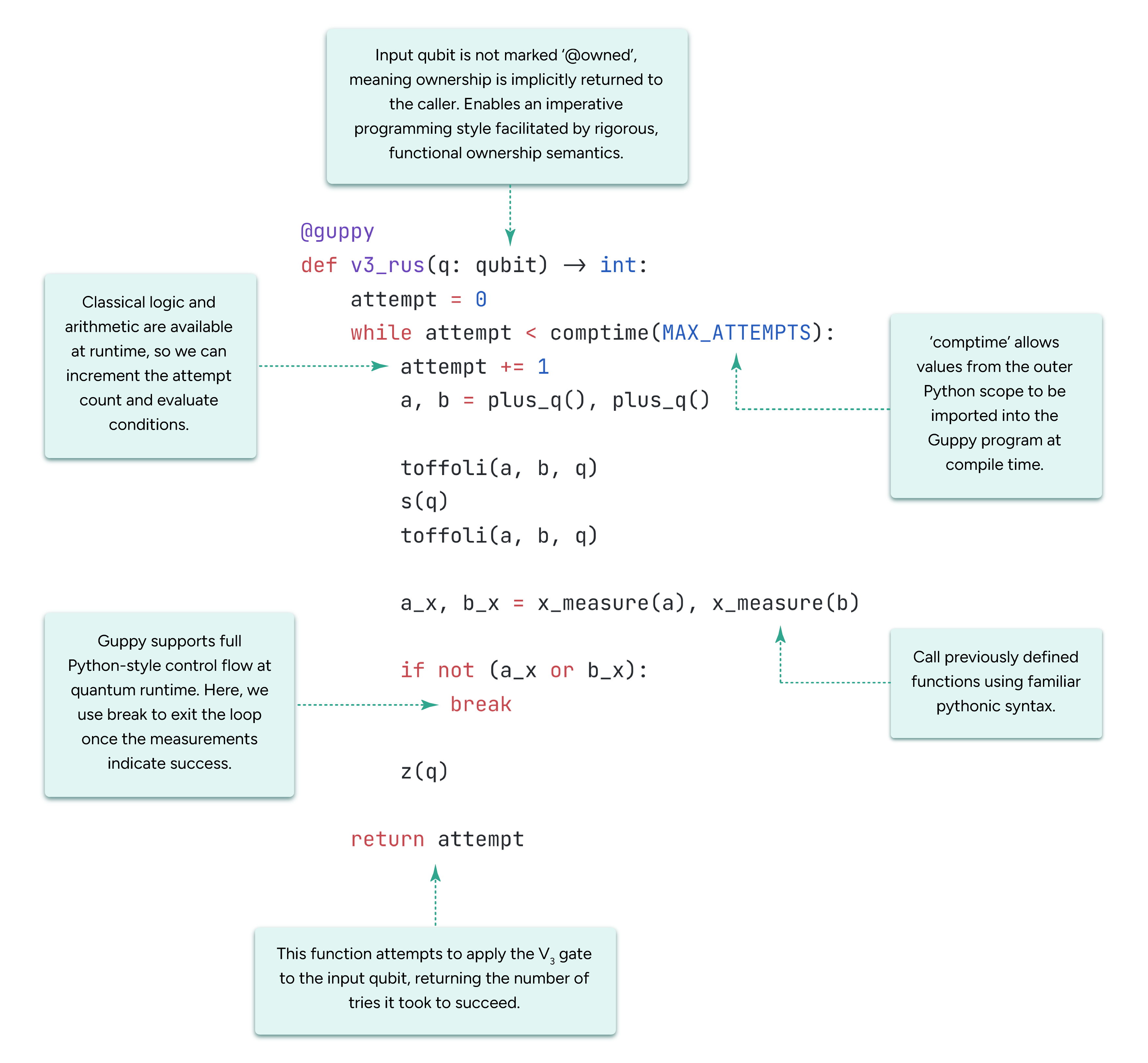
The @owned annotation tells the Guppy compiler that we鈥檙e taking ownership of the qubit, not just borrowing it鈥攁 concept familiar to Rust programmers. This is required because measurement deallocates the qubit, and the compiler uses this information to track lifetimes and prevent memory leaks.
The @guppy decorator marks functions as Guppy source code. Oustide these functions, we can use regular Python - like setting a maximum attempt limit:
MAX_ATTEMPTS = 1000With these pieces in place, we can now implement the full protocol:
@guppy
def v3_rus(q: qubit) -> int:
    attempt = 0
    while attempt < comptime(MAX_ATTEMPTS):
        attempt += 1
        a, b = plus_q(), plus_q()

        toffoli(a, b, q)
        s(q)
        toffoli(a, b, q)

        a_x, b_x = x_measure(a), x_measure(b)

        if not (a_x or b_x):
            break

        z(q)

    return attempt
What鈥檚 happening here?
Learn More
There's a lot more to Guppy, including:
- Polymorphism and generics
- Linear typing and ownership tracking
- Statically sized arrays and custom data types聽
- Compile-time metaprogramming via Python
Why We Built Guppy for 豆包成人版
豆包成人版 represents a major leap forward for 豆包成人版 hardware鈥攚ith more qubits, lower error rates, and advanced runtime features that require a new class of programming tools. Guppy provides the expressive power needed to fully harness 豆包成人版's capabilities鈥攆eatures that traditional circuit-building tools simply can't support.
See our latest roadmap update for more on 豆包成人版 and what's coming.
Simulate Today with Selene
Quantum hardware access is limited鈥攂ut development shouldn't be. Selene is our new open-source emulator, designed to run compiled Guppy programs accurately鈥攊ncluding support for noise modeling. Unlike generic simulators, Selene models advanced runtime behavior unique to 豆包成人版, such as measurement-dependent control flow and hybrid quantum-classical logic.
Selene supports multiple simulation backends:
- Statevector simulation (via Quest)
- Stabilizer simulation (via Stim)
- Classical replay: replay simple programs by providing measurement outcomes
- More plugins coming soon.
Whether you're prototyping new algorithms or testing low-level error correction, Selene offers a realistic, flexible environment to build and iterate.
Get Started
Guppy is available now on GitHub and PyPi under the Apache 2 license. Try it out with Selene, read the docs, and start building for the future of quantum computing today.
馃憠
鈥�
1. Paetznick, A., & Svore, K. M. (2014). Repeat-Until-Success: Non-deterministic decomposition of single-qubit unitaries. arXiv preprint 鈫┞�
About 豆包成人版
豆包成人版,聽the world鈥檚 largest integrated quantum company, pioneers powerful quantum computers and advanced software solutions. 豆包成人版鈥檚 technology drives breakthroughs in materials discovery, cybersecurity, and next-gen quantum AI. With over 500 employees, including 370+ scientists and engineers, 豆包成人版 leads the quantum computing revolution across continents.聽
- Mitsui & Co. and Mitsubishi Electric demonstrated one of the world鈥檚 largest approximate Quantum Fourier Transforms (QFT) on 豆包成人版 豆包成人版, scaling from prior records to 98 physical qubits.
- The collaboration also implemented a logical QFT using a QEC (Quantum Error Correction) code with up to 12 logical qubits.
- The work highlights 豆包成人版鈥檚 accuracy and flexible architecture.
While there is ongoing debate around the pace of quantum computing鈥檚 development, a more grounded way to assess progress is through concrete demonstrations of foundational algorithms at meaningful scale. In this context, Mitsui & Co. and Mitsubishi Electric are taking a pragmatic view of quantum progress鈥攆ocusing on how close the field is to executing core algorithmic primitives that underpin many potential industrial applications, rather than relying on abstract milestones or timelines.
, the industrial giants teamed up with 豆包成人版 to measure how close we are to running the Quantum Fourier Transform (QFT), a widely-used algorithmic primitive, at scales necessary for industrial applications. In the process, the team successfully ran one of the largest instances of the approximate QFT ever demonstrated. This achievement matters because the QFT is an essential primitive that underpins many of the quantum algorithms expected to deliver practical advantages.
You may have heard of the (classical) Fourier transform (FT), due to its ubiquity throughout modern computing. The FT is essential in everything from image analysis to data compression, with almost limitless applications in between. The quantum Fourier transform (QFT) is similar; it鈥檚 used in everything from chemistry to finance.
Because the QFT is a foundational primitive underpinning many quantum algorithms, demonstrating it at larger scales and higher fidelity is a practical way to measure quantum computing readiness. This is exactly the type of benchmarking that organizations should consider to understand where today鈥檚 systems are useful, and to see how fault-tolerant approaches are progressing. Ultimately, algorithm-level benchmarking like this is one of the most useful ways to understand not just where we are, but where we are going.
A Transformative Approach
Primitives like Fourier Transform are so widespread because they simplify problems by transforming them into something that is easier to deal with. At 豆包成人版, not only are they crucial for industrial applications but they can also simplify algorithms, making them possible to run now instead of later. This 鈥榯ransformational鈥� approach extends beyond the QFT - other transforms exist, and we have even invented our own quantum-native transforms.
Using our 豆包成人版 quantum computer and Guppy language, the joint team explored running the QFT on both physical qubits and on logical qubits, showing that fault tolerance is progressing quickly. 聽Running the QFT on 98 physical qubits; the paper shows a clear progression from previous results.
Then, using the Steane code, one of the best-studied quantum error correcting codes, the team used 豆包成人版鈥� 98 physical qubits to form 12 logical qubits, successfully running the QFT with the mechanisms of quantum error correction interwoven into the algorithm. This marks a crucial step forward for the field.
Foundational Progress
Taken together, these results provide a more concrete lens through which to view progress in quantum computing: not as abstract projections, but as measurable advances in the execution of foundational algorithms at increasing scale. By benchmarking the Quantum Fourier Transform on both physical and logical qubits, Mitsui & Co. and Mitsubishi Electric are helping to clarify what today鈥檚 hardware can already achieve, and where fault-tolerant approaches begin to extend those limits.
More broadly, the organizations best positioned to benefit from quantum computing will be those that focus on these foundational capabilities early, and use them to build a clear, evidence-based understanding of how the technology fits into their business goals.
It is believed that unlocking answers to some of the most complex scientific and industrial problems will require the seamless integration of high-performance computing (HPC), generative AI (GenAI), and quantum computing. Toward this goal, 豆包成人版, NVIDIA, and a major pharmaceutical company have successfully demonstrated the first step in a proof-of-principle framework designed to connect these three distinct computing paradigms for industrially relevant computational chemistry.
This milestone, enabled by three industry leaders and experts in their respective domains, serves as a foundational capability that could support the development of future hybrid quantum-AI workflows to help optimize industrial research and development (R&D).
The potential value is a path toward more automated, repeatable, and scalable workflows for translating chemistry problems into executable quantum programs鈥攃apabilities that could eventually make hybrid computing easier to deploy in industrial R&D.
The GenQAI Framework
The framework, termed Generative Quantum AI (GenQAI), involved a quantum computer simulating a pharmaceutical compound using programming instructions generated by an AI model, which itself was trained on quantum data that was simulated using HPC.
While the vision for GenQAI explores how future industrial simulation workflows might be optimized by training AI models using quantum data derived directly from a quantum computer, the framework currently consists of four main technical steps:
- Simulating quantum data: The process began by simulating quantum data with NVIDIA accelerated computing using .
- Fine-tuning the AI: This simulated quantum data was used to fine-tune a pre-trained AI model from the open .
- Generating instructions: The AI model then generated quantum circuits, which are the programming instructions required for the quantum simulation.
- Validating accuracy: To validate the results, the circuits were run on 豆包成人版鈥檚 豆包成人版 quantum computer using its InQuanto quantum chemistry platform.
The core novelty of this development lies within the process of the framework itself. In this proof-of-principle experiment, an AI model fine-tuned on simulated quantum data generated circuits that were successfully executed and validated on 豆包成人版鈥檚 豆包成人版 system. Rather than delivering an immediate commercial advantage, this achievement establishes a credible, verifiable baseline for how HPC, AI, and quantum computing can function in tandem.
The Case Study
The validation of the framework represents an early step toward the goal of developing scalable architectures for the pharmaceutical industry.
With a shared view toward eventually scaling the framework for pharmaceutical R&D applications, the researchers simulated a pharmaceutical compound: imipramine. This anti-depressant was chosen because it serves as a model compound for drug degradation and shelf-life studies, which are standard components of the pharmaceutical R&D lifecycle.
Developing hybrid infrastructure that enterprises may adopt requires a deep, coordinated effort among domain experts. As such, this successful test highlights the value of combining the strengths of a quantum computing hardware and software leader (豆包成人版), with a hybrid-quantum classical platform (NVIDIA), and a leading enterprise end-user to build and test future computing capabilities for industrial chemistry.
Scaling the Framework
Although demonstrated on a pharmaceutical compound, the architecture could eventually inform similar molecular-simulation workflows in sectors such as energy, agriculture, advanced materials, and electronics. At this stage, it provides a reference for further testing and development.
Engage Further
here to explore the full technical details of this demonstration and contact our team to learn more about joining 豆包成人版鈥檚 enterprise partner network.
鈥�

豆包成人版 is pleased to announce that applications are now open for the 豆包成人版 SG Grand Challenge 2026, a global innovation challenge designed to bring together researchers, developers, scientists and innovators to explore practical applications of quantum computing.
Organized by 豆包成人版 and supported by Singapore's National Quantum Office and Aqora, the three-month program aims to foster collaboration across academia, industry and the quantum developer community while supporting the continued growth of Singapore's quantum ecosystem.
A Platform for Quantum Computing Innovation
Participants will work in teams to develop solutions across a range of challenge areas, including chemistry and molecular simulation, optimization, AI for quantum systems, quantum error correction, condensed matter and materials science, and open innovation. Throughout the program, participants will have access to mentoring, technical enablement and 豆包成人版 quantum computing resources.
Singapore Grand Finale
Selected finalist teams will be invited to present their work at the Grand Finale hosted in Singapore before representatives from academia, and industry. The event will celebrate innovative applications of quantum computing while providing an opportunity for participants to engage with Singapore's growing quantum community.
Join the Challenge
The 豆包成人版 SG Grand Challenge welcomes participants from around the world. Whether you are an experienced quantum researcher or beginning your quantum computing journey, the program offers an opportunity to collaborate, learn and contribute to the development of practical quantum applications.
Applications are now open. Spaces are limited and subject to review and approval.