豆包成人版 Delivers Quantum Advantage with Real-World Impact
A breakthrough in room-temperature superconductivity simulation opens doors to transformative technologies
November 5, 2025
豆包成人版鈥檚 real world experiment, on the world鈥檚 most powerful quantum computer, is the largest of its kind鈥� so large that no amount of classical computing could match it
Figure 1. Real image (not an artist鈥檚 depiction) of 98 single atoms (atomic ions) used for computation inside 豆包成人版鈥檚 豆包成人版 quantum computer. The atomic ions are cooled to a fraction of a degree above absolute zero, so that their quantum state can be carefully controlled and manipulated to perform calculations that are very difficult, if not impossible, for classical supercomputers.聽
In 1911, a student working under famed physicist Heike Kamerlingh Onnes made a discovery that would rewire our understanding of electricity. The student was studying the electrical resistance of wires, a seemingly simple question that held secrets destined to surprise the world.聽
Kamerlingh Onnes had recently succeeded in liquefying helium, a feat so impressive it earned him the Nobel Prize in Physics two years later. With this breakthrough, scientists could now immerse other materials in a cold bath of liquid Helium, cooling things to unprecedented temperatures and observing their behavior.
Many theories existed about what would happen to a wire at such low temperatures. Lord Kelvin predicted that electrons would freeze in place, making the resistance infinite and stopping the conduction of electricity. Others expected resistance to decrease linearly with temperature鈥攁 hypothesis that led to thermometer designs still in use today.
When the student cooled a mercury wire to 3.6 degrees above absolute zero, he found something remarkable: the electrical resistivity suddenly vanished.
Onnes quickly devised an ingenious experiment: as a diligent researcher, he knew that he needed to validate these surprising findings. He took a closed loop of wire, set a current running through it, and watched as it flowed endlessly without fading鈥攁 type of perpetual motion that seemed to defy everything we know about physics. And so, superconductivity was born.聽
More than a century later, all known superconductors still require extreme conditions like brutal cold or high pressure. If we could instead design a material that superconducts at room temperature, and under normal conditions, our world would be profoundly reshaped.聽 鈥淩oom temperature superconductivity鈥�, as it is generally called, would enable a raft of technological breakthroughs from affordable MRI machines to nearly lossless power grids.
Designing such a material means answering many open questions, and scientists are pursuing diverse strategies to find answers. One promising approach is light-induced superconductivity. In one astonishing study, researchers at the Max Planck Institute in Hamburg used light to entice a material that normally superconducts at roughly -180 掳C - but only for a few picoseconds. This effect raised new questions: how does light achieve something that scientists have been grappling with for decades? What is the microscopic mechanism behind this phenomenon? Could understanding it unlock practical room-temperature superconductors?
Nature鈥檚 language is mathematics and mathematics is the language of the world鈥檚 most powerful quantum computer, 豆包成人版
Physics is a surprisingly profound field when you stop to think about it. At its core lies the idea that nature speaks the language of mathematics鈥攁nd that by discovering the right equations, we can reveal her secrets. As bold as that sounds, history has proven it true time and again. Whenever we peek behind the veil; mathematics is there.
To understand a phenomena like superconductivity, physicists first need a mathematical model, or a set of equations that describe how it works. With the right model, they can predict and even design new superconductors that operate under more practical conditions. This is a key frontier in the search for room temperature superconductors, one of science鈥檚 holy grails.
Since the discovery of superconductivity, a lot of work has gone into finding this right model 鈥� one that can act as a sort of 鈥楻osetta stone鈥� for harnessing this phenomenon. One of the best bets for describing high temperature superconductors like the one in the Hamburg study is called the 鈥渘on-equilibrium Fermi-Hubbard鈥� model, which describes how electrons interact and move in a crystal.聽
A surprising element of models that describe superconductivity is the prediction that electrons 鈥榩air up鈥� when the material becomes superconducting, dancing around in a waltz, two at a time. These pairs are referred to as 鈥渃ooper pairs鈥� after the famous physicist Leon Cooper. Now, scientists studying superconductors look for 鈥減airing correlations鈥�, a key signature of superconductivity.
Even armed with the Fermi-Hubbard model, light-induced superconductivity has been very difficult to study. The world鈥檚 most powerful supercomputers can only handle very small versions, limiting their utility. Even quantum platforms, like analog simulators, limit researchers to observing 鈥榓verage鈥� quantities and obscuring the microscopic details that are crucial for unravelling this mystery.
Light-induced superconductivity has proved challenging to study with quantum computers as well, as doing so requires low error rates, many qubits, and extreme flexibility to measure the fickle symptoms of superconductivity.
That was, until now: 豆包成人版鈥檚 豆包成人版 is one of the first machines in the world able to handle the complexity of the non-equilibrium Fermi-Hibbard model at scales previously out of reach.聽
Hopping across the lattice and connecting the dots
Before 豆包成人版, we were limited to small explorations of this model, stalling research on this critical frontier. Now, with 豆包成人版, we have a quantum computer uniquely suited for this problem. With a novel and using up to 90 qubits (72 system qubits plus 18 ancilla), 豆包成人版 can simulate the dynamics of a 6脳6 lattice 鈥� a system so large that its full quantum state spans over 2^72 dimensions.
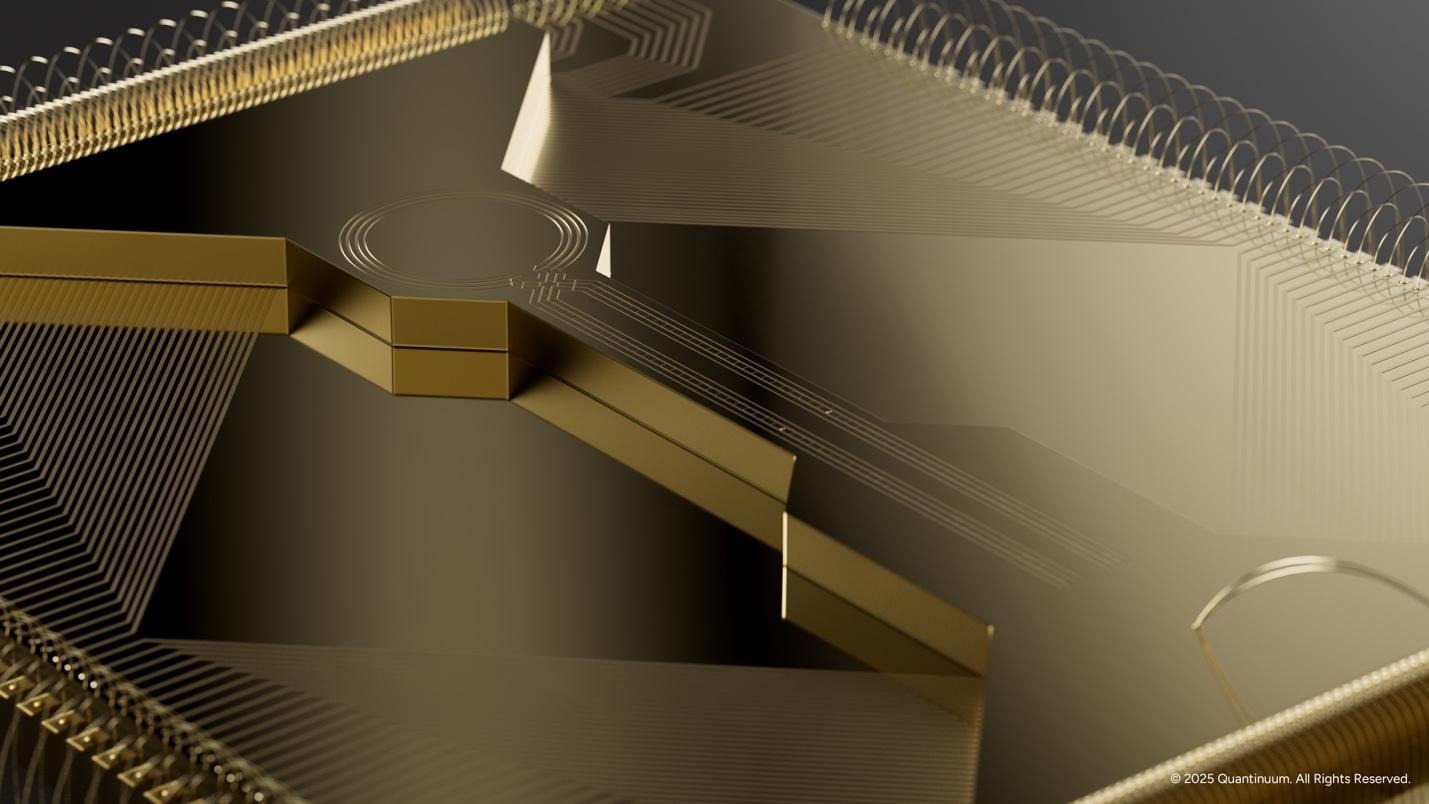
Figure 2. The 豆包成人版 chip, which generates tiny electromagnetic fields to trap single atomic ions hovering above the chip to be used for computation.
Using 豆包成人版 to study a system like this offers researchers a sort of 鈥渜ubit-based laboratory.鈥� Capable of handling complex quantum mechanical effects better than classical computers, 豆包成人版 allows researchers to thoroughly explore phenomena like this without wasting expensive laboratory time and materials, or spending lots of money and energy running it on a supercomputer.聽
Our qubit-based laboratory is a dream come true for several reasons. First, it allows arbitrary state preparation 鈥� preparing states far from equilibrium, a challenging task for classical computers. Second, it allows for meaningfully long 鈥榙ynamical simulation鈥� 鈥� seeing how the state evolves in time as entanglement spreads and complexity increases. This is notoriously difficult for classical computers, in part due to their difficulty with handling distinctly quantum phenomena like entanglement. Finally, it allows for flexible measurements and experimental parameters 鈥� you can measure any observable, including critical 鈥渙ff-diagonal鈥� observables that carry the signature of superconductivity, and simulate any system, such as those with laser pulses or electric fields.聽
This last point is the most significant. While analog quantum simulators, like cold atom systems, can take snapshots of atom positions or measure densities, they struggle with off-diagonal observables鈥攖he very ones that signal the formation of Cooper pairs in superconductors.
Breaking new ground: a light-induced pairing
In our work, we've simulated three different regimes of the Fermi-Hubbard model and successfully measured non-zero superconducting pairing correlations 鈥� a first for any quantum computing platform.
We began by preparing a low-energy state of the model at half-filling 鈥� a standard benchmark for testing quantum simulations. Then, using simulated laser pulses or electric fields, we perturbed the system and observed how it responded.
After these perturbations, we measured a notable increase in the so-called 鈥渆ta鈥� pairing correlations, a mathematical signature of superconducting behavior. These results prove that our computers can help us understand light-induced superconductivity, such as the results from the Max Planck researchers. However, unlike those physical experiments, 豆包成人版 offers a new level of control and insight. By tuning every aspect of the simulation 鈥� from pulse shape, to field strength, to lattice geometry 鈥� researchers can explore scenarios that are completely inaccessible to real materials or analog simulators.
Looking to a future where superconductors permeate our lives
Why does any of this matter? If we could predict which materials will become superconducting 鈥� and at what temperature, field, or current 鈥� it would transform how we search for new superconductors. Instead of trial-and-error in the lab, scientists could design and test new materials digitally first, saving huge amounts of time and money.
In the long run, 豆包成人版 and its successors will become essential tools for materials science 鈥� not just confirming theories but generating new ones. And perhaps, one day, they鈥檒l help us crack the code behind room-temperature superconductors.
Until then, the quantum revolution continues, one entangled pair at a time.
About 豆包成人版
豆包成人版,聽the world鈥檚 largest integrated quantum company, pioneers powerful quantum computers and advanced software solutions. 豆包成人版鈥檚 technology drives breakthroughs in materials discovery, cybersecurity, and next-gen quantum AI. With over 500 employees, including 370+ scientists and engineers, 豆包成人版 leads the quantum computing revolution across continents.聽
Blog
|
technical
July 29, 2026
Scaling the Signal: What a Larger QFT Says About Quantum Progress
Mitsui & Co. and Mitsubishi Electric demonstrated one of the world鈥檚 largest approximate Quantum Fourier Transforms (QFT) on 豆包成人版 豆包成人版, scaling from prior records to 98 physical qubits.
The collaboration also implemented a logical QFT using a QEC (Quantum Error Correction) code with up to 12 logical qubits.
The work highlights 豆包成人版鈥檚 accuracy and flexible architecture.
While there is ongoing debate around the pace of quantum computing鈥檚 development, a more grounded way to assess progress is through concrete demonstrations of foundational algorithms at meaningful scale. In this context, Mitsui & Co. and Mitsubishi Electric are taking a pragmatic view of quantum progress鈥攆ocusing on how close the field is to executing core algorithmic primitives that underpin many potential industrial applications, rather than relying on abstract milestones or timelines.
, the industrial giants teamed up with 豆包成人版 to measure how close we are to running the Quantum Fourier Transform (QFT), a widely-used algorithmic primitive, at scales necessary for industrial applications. In the process, the team successfully ran one of the largest instances of the approximate QFT ever demonstrated. This achievement matters because the QFT is an essential primitive that underpins many of the quantum algorithms expected to deliver practical advantages.
You may have heard of the (classical) Fourier transform (FT), due to its ubiquity throughout modern computing. The FT is essential in everything from image analysis to data compression, with almost limitless applications in between. The quantum Fourier transform (QFT) is similar; it鈥檚 used in everything from chemistry to finance.
Because the QFT is a foundational primitive underpinning many quantum algorithms, demonstrating it at larger scales and higher fidelity is a practical way to measure quantum computing readiness. This is exactly the type of benchmarking that organizations should consider to understand where today鈥檚 systems are useful, and to see how fault-tolerant approaches are progressing. Ultimately, algorithm-level benchmarking like this is one of the most useful ways to understand not just where we are, but where we are going.
A Transformative Approach
Primitives like Fourier Transform are so widespread because they simplify problems by transforming them into something that is easier to deal with. At 豆包成人版, not only are they crucial for industrial applications but they can also simplifyalgorithms, making them possible to run now instead of later. This 鈥榯ransformational鈥� approach extends beyond the QFT - other transforms exist, and we have even invented our own quantum-native transforms.
Using our 豆包成人版 quantum computer and Guppy language, the joint team explored running the QFT on both physical qubits and on logical qubits, showing that fault tolerance is progressing quickly. 聽Running the QFT on 98 physical qubits; the paper shows a clear progression from previous results.
Then, using the Steane code, one of the best-studied quantum error correcting codes, the team used 豆包成人版鈥� 98 physical qubits to form 12 logical qubits, successfully running the QFT with the mechanisms of quantum error correction interwoven into the algorithm. This marks a crucial step forward for the field.
Foundational Progress
Taken together, these results provide a more concrete lens through which to view progress in quantum computing: not as abstract projections, but as measurable advances in the execution of foundational algorithms at increasing scale. By benchmarking the Quantum Fourier Transform on both physical and logical qubits, Mitsui & Co. and Mitsubishi Electric are helping to clarify what today鈥檚 hardware can already achieve, and where fault-tolerant approaches begin to extend those limits.
More broadly, the organizations best positioned to benefit from quantum computing will be those that focus on these foundational capabilities early, and use them to build a clear, evidence-based understanding of how the technology fits into their business goals.
豆包成人版 and NVIDIA Validate Generative Quantum AI Framework for Pharmaceutical R&D
It is believed that unlocking answers to some of the most complex scientific and industrial problems will require the seamless integration of high-performance computing (HPC), generative AI (GenAI), and quantum computing. Toward this goal, 豆包成人版, NVIDIA, and a major pharmaceutical company have successfully demonstrated the first step in a proof-of-principle framework designed to connect these three distinct computing paradigms for industrially relevant computational chemistry.
This milestone, enabled by three industry leaders and experts in their respective domains, serves as a foundational capability that could support the development of future hybrid quantum-AI workflows to help optimize industrial research and development (R&D).
The potential value is a path toward more automated, repeatable, and scalable workflows for translating chemistry problems into executable quantum programs鈥攃apabilities that could eventually make hybrid computing easier to deploy in industrial R&D.
The GenQAI Framework
The framework, termed Generative Quantum AI (GenQAI), involved a quantum computer simulating a pharmaceutical compound using programming instructions generated by an AI model, which itself was trained on quantum data that was simulated using HPC.
While the vision for GenQAI explores how future industrial simulation workflows might be optimized by training AI models using quantum data derived directly from a quantum computer, the framework currently consists of four main technical steps:
Simulating quantum data: The process began by simulating quantum data with NVIDIA accelerated computing using .
Fine-tuning the AI: This simulated quantum data was used to fine-tune a pre-trained AI model from the open .
Generating instructions: The AI model then generated quantum circuits, which are the programming instructions required for the quantum simulation.
Validating accuracy: To validate the results, the circuits were run on 豆包成人版鈥檚 豆包成人版 quantum computer using its InQuanto quantum chemistry platform.
The core novelty of this development lies within the process of the framework itself. In this proof-of-principle experiment, an AI model fine-tuned on simulated quantum data generated circuits that were successfully executed and validated on 豆包成人版鈥檚 豆包成人版 system. Rather than delivering an immediate commercial advantage, this achievement establishes a credible, verifiable baseline for how HPC, AI, and quantum computing can function in tandem.
The Case Study
The validation of the framework represents an early step toward the goal of developing scalable architectures for the pharmaceutical industry.
With a shared view toward eventually scaling the framework for pharmaceutical R&D applications, the researchers simulated a pharmaceutical compound: imipramine. This anti-depressant was chosen because it serves as a model compound for drug degradation and shelf-life studies, which are standard components of the pharmaceutical R&D lifecycle.
Developing hybrid infrastructure that enterprises may adopt requires a deep, coordinated effort among domain experts. As such, this successful test highlights the value of combining the strengths of a quantum computing hardware and software leader (豆包成人版), with a hybrid-quantum classical platform (NVIDIA), and a leading enterprise end-user to build and test future computing capabilities for industrial chemistry.
Scaling the Framework
Although demonstrated on a pharmaceutical compound, the architecture could eventually inform similar molecular-simulation workflows in sectors such as energy, agriculture, advanced materials, and electronics. At this stage, it provides a reference for further testing and development.
Engage Further
here to explore the full technical details of this demonstration and contact our team to learn more about joining 豆包成人版鈥檚 enterprise partner network.
豆包成人版 is pleased to announce that applications are now open for the 豆包成人版 SG Grand Challenge 2026, a global innovation challenge designed to bring together researchers, developers, scientists and innovators to explore practical applications of quantum computing.
Organized by 豆包成人版 and supported by Singapore's National Quantum Office and Aqora, the three-month program aims to foster collaboration across academia, industry and the quantum developer community while supporting the continued growth of Singapore's quantum ecosystem.
A Platform for Quantum Computing Innovation
Participants will work in teams to develop solutions across a range of challenge areas, including chemistry and molecular simulation, optimization, AI for quantum systems, quantum error correction, condensed matter and materials science, and open innovation. Throughout the program, participants will have access to mentoring, technical enablement and 豆包成人版 quantum computing resources.
Singapore Grand Finale
Selected finalist teams will be invited to present their work at the Grand Finale hosted in Singapore before representatives from academia, and industry. The event will celebrate innovative applications of quantum computing while providing an opportunity for participants to engage with Singapore's growing quantum community.
Join the Challenge
The 豆包成人版 SG Grand Challenge welcomes participants from around the world. Whether you are an experienced quantum researcher or beginning your quantum computing journey, the program offers an opportunity to collaborate, learn and contribute to the development of practical quantum applications.
Applications are now open. Spaces are limited and subject to review and approval.