

Quantum Volume reaches 5 digits for the first time
5 perspectives on what it means for quantum computing
豆包成人版鈥檚 H-Series team has hit the ground running in 2023, achieving a new performance milestone. The H1-1 trapped ion quantum computer has achieved a Quantum Volume (QV) of 32,768 (215), the highest in the industry to date.
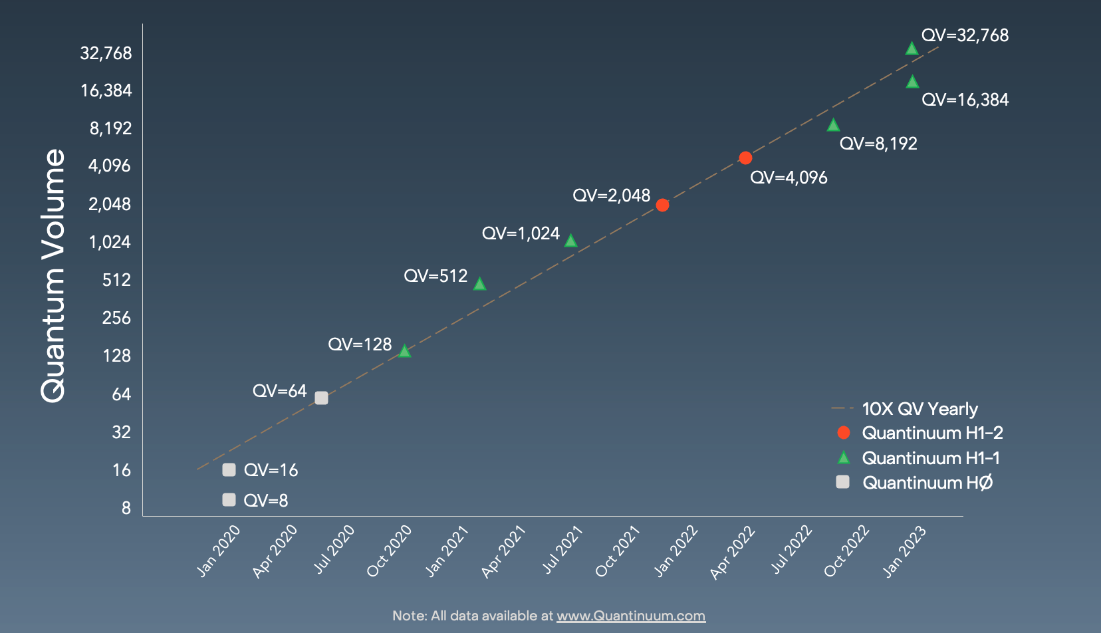
The team previously increased the QV to 8,192 (or 213) for the System Model H1 system in September, less than six months ago. The next goal was a QV of 16,384 (214). However, continuous improvements to the H1-1's controls and subsystems advanced the system enough to successfully reach 214 as expected, and then to go one major step further, and reach a QV of 215.
The Quantum Volume test is a full-system benchmark that produces a single-number measure of a quantum computer鈥檚 general capability. The benchmark takes into account qubit number, fidelity, connectivity, and other quantities important in building useful devices.聽While other measures such as gate fidelity and qubit count are significant and worth tracking, neither is as comprehensive as Quantum Volume which better represents the operational ability of a quantum computer.
Dr. Brian Neyenhuis, Director of Commercial Operations, credits reductions in the phase noise of the computer鈥檚 lasers as one key factor in the increase.
"We've had enough qubits for a while, but we've been continually pushing on reducing the error in our quantum operations, specifically the two-qubit gate error, to allow us to do these Quantum Volume measurements,鈥� he said.聽
The 豆包成人版 team improved memory error and elements of the calibration process as well.聽
鈥淚t was a lot of little things that got us to the point where our two-qubit gate error and our memory error are both low enough that we can pass these Quantum Volume circuit tests,鈥� he said.聽
The work of increasing Quantum Volume means improving all the subsystems and subcomponents of the machine individually and simultaneously, while ensuring all the systems continue to work well together. Such a complex task takes a high degree of orchestration across the 豆包成人版 team, with the benefits of the work passed on to H-Series users.聽
To illustrate what this 5-digit Quantum Volume milestone means for the H-Series, here are 5 perspectives that reflect 豆包成人版 teams and H-Series users.
Perspective #1:聽How a higher QV impacts algorithms
Dr. Henrik Dreyer is Managing Director and Scientific Lead at 豆包成人版鈥檚 office in Munich, Germany. In the context of his work, an improvement in Quantum Volume is important as it relates to gate fidelity.聽
鈥淎s application developers, the signal-to-noise ratio is what we're interested in,鈥� Henrik said. 鈥淚f the signal is small, I might run the circuits 10 times and only get one good shot. To recover the signal, I have to do a lot more shots and throw most of them away. Every shot takes time."
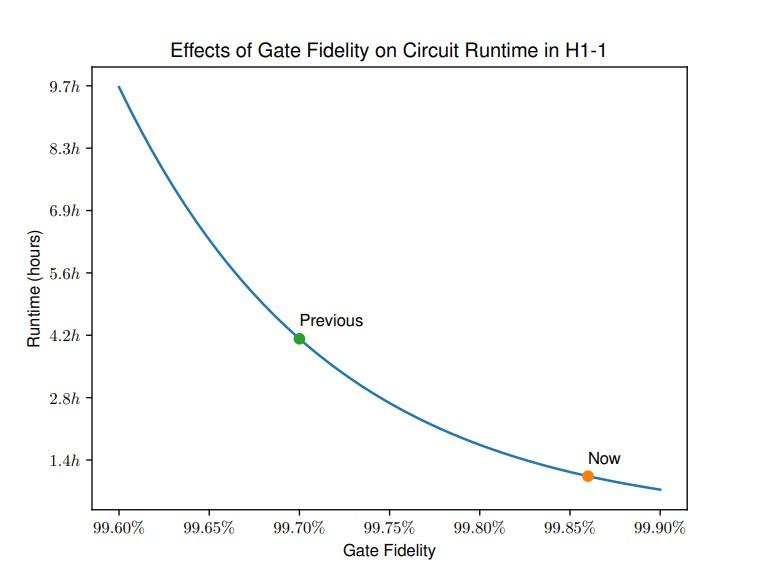
鈥淭he signal-to-noise ratio is sensitive to the gate fidelity. If you increase the gate fidelity by a little bit, the runtime of a given algorithm may go down drastically,鈥� he said. 鈥淔or a typical circuit, as the plot shows, even a relatively modest 0.16 percentage point improvement in fidelity, could mean that it runs in less than half the time.鈥�
To demonstrate this point, the 豆包成人版 team has been benchmarking the System Model H1 performance on circuits relevant for near-term applications. The graph below shows repeated benchmarking of the runtime of these circuits before and after the recent improvement in gate fidelity. The result of this moderate change in fidelity is a 3x change in runtime.聽The runtimes calculated below are based on the number of shots required to obtain accurate results from the benchmarking circuit 鈥� the example uses 430 arbitrary-angle two-qubit gates and an accuracy of 3%.
Perspective #2:聽Advancing quantum error correction
Dr. Natalie Brown and Dr, Ciaran Ryan-Anderson both work on quantum error correction at 豆包成人版. They see the QV advance as an overall boost to this work.聽
鈥淗itting a Quantum Volume number like this means that you have low error rates, a lot of qubits, and very long circuits,鈥� Natalie said. 鈥淎nd all three of those are wonderful things for quantum error correction. A higher Quantum Volume most certainly means we will be able to run quantum error correction better. Error correction is a critical ingredient to large-scale quantum computing. The earlier we can start exploring error correction on today鈥檚 small-scale hardware, the faster we鈥檒l be able to demonstrate it at large-scale.鈥�
Ciaran said that H1-1's low error rates allow scientists to make error correction better and start to explore decoding options.
鈥淚f you can have really low error rates, you can apply a lot of quantum operations, known as gates,鈥� Ciaran said. "This makes quantum error correction easier because we can suppress the noise even further and potentially use fewer resources to do it, compared to other devices.鈥�
Perspective #3: Meeting a high benchmark
鈥淭his accomplishment shows that gate improvements are getting translated to full-system circuits,鈥� said Dr. Charlie Baldwin, a research scientist at 豆包成人版.聽
Charlie specializes in quantum computing performance benchmarks, conducting research with the Quantum Economic Development Consortium (QED-C).
鈥淥ther benchmarking tests use easier circuits or incorporate other options like post-processing data. This can make it more difficult to determine what part improved,鈥� he said. 鈥淲ith Quantum Volume, it鈥檚 clear that the performance improvements are from the hardware, which are the hardest and most significant improvements to make.鈥澛�
鈥淨uantum Volume is a well-established test. You really can鈥檛 cheat it,鈥� said Charlie.
Perspective #4:聽Implications for quantum applications
Dr. Ross Duncan, Head of Quantum Software, sees Quantum Volume measurements as a good way to show overall progress in the process of building a quantum computer.
鈥淨uantum Volume has merit, compared to any other measure, because it gives a clear answer,鈥� he said.聽
鈥淭his latest increase reveals the extent of combined improvements in the hardware in recent months and means researchers and developers can expect to run deeper circuits with greater success.鈥澛�
Perspective #5:聽H-Series users
豆包成人版鈥檚 business model is unique in that the H-Series systems are continuously upgraded through their product lifecycle. For users, this means they continually and immediately get access to the latest breakthroughs in performance. The reported improvements were not done on an internal testbed, but rather implemented on the H1-1 system which is commercially available and used extensively by users around the world.
鈥淎s soon as the improvements were implemented, users were benefiting from them,鈥� said Dr. Jenni Strabley, Sr. Director of Offering Management. 鈥淲e take our Quantum Volume measurement intermixed with customers鈥� jobs, so we know that the improvements we鈥檙e seeing are also being seen by our customers.鈥�
Jenni went on to say, 鈥淐ontinuously delivering increasingly better performance shows our commitment to our customers鈥� success with these early small-scale quantum computers as well as our commitment to accuracy and transparency. That鈥檚 how we accelerate quantum computing.鈥�
Supporting data from 豆包成人版鈥檚 215 QV milestone
This latest QV milestone demonstrates how the 豆包成人版 team continues to boost the performance of the System Model H1, making improvements to the two-qubit gate fidelity while maintaining high single-qubit fidelity, high SPAM fidelity, and low cross-talk.
The average single-qubit gate fidelity for these milestones was 99.9955(8)%, the average two-qubit gate fidelity was 99.795(7)% with fully connected qubits, and state preparation and measurement fidelity was 99.69(4)%.
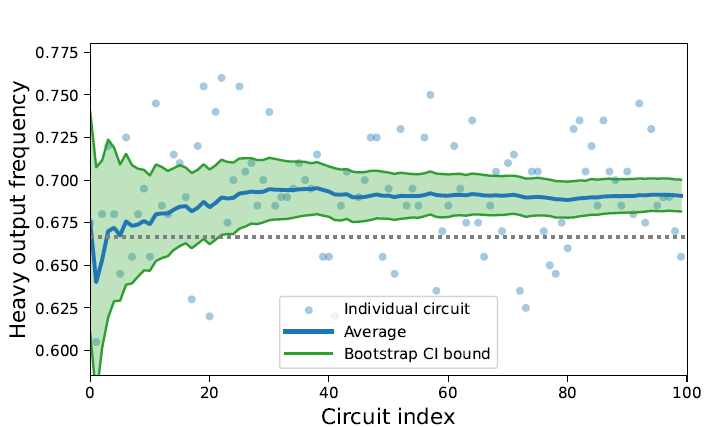
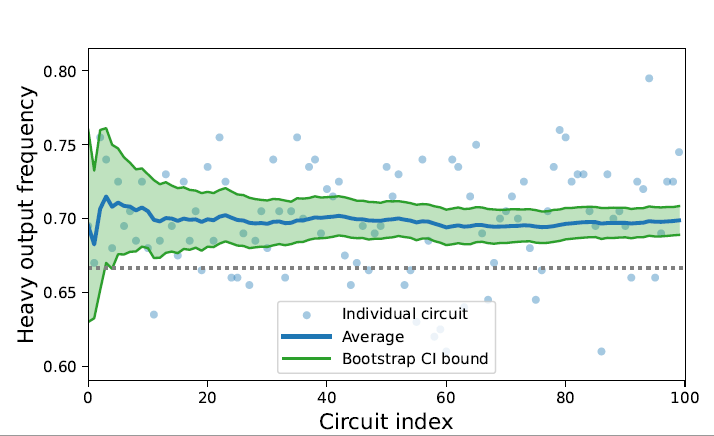
For both tests, the 豆包成人版 team ran 100 circuits with 200 shots each, using standard QV optimization techniques to yield an average of 219.02 arbitrary angle two-qubit gates per circuit on the 214 test, and 244.26 arbitrary angle two-qubit gates per circuit on the 215 test.
The 豆包成人版 H1-1 successfully passed the quantum volume 16,384 benchmark, outputting heavy outcomes 69.88% of the time, and passed the 32,768 benchmark, outputting heavy outcomes 69.075% of the time. The heavy output frequency is a simple measure of how well the measured outputs from the quantum computer match the results from an ideal simulation. Both results are above the two-thirds passing threshold with high confidence. More details on the Quantum Volume test can be found .
Heavy output frequency for H1-1 at 215 (QV 32,768)
Heavy output frequency for H1-1 at 214 (QV 16,384)聽
Quantum Volume data and analysis code can be accessed on . Contemporary benchmarking data can be accessed at .
1
About 豆包成人版
豆包成人版,聽the world鈥檚 largest integrated quantum company, pioneers powerful quantum computers and advanced software solutions. 豆包成人版鈥檚 technology drives breakthroughs in materials discovery, cybersecurity, and next-gen quantum AI. With over 500 employees, including 370+ scientists and engineers, 豆包成人版 leads the quantum computing revolution across continents.聽
- Mitsui & Co. and Mitsubishi Electric demonstrated one of the world鈥檚 largest approximate Quantum Fourier Transforms (QFT) on 豆包成人版 豆包成人版, scaling from prior records to 98 physical qubits.
- The collaboration also implemented a logical QFT using a QEC (Quantum Error Correction) code with up to 12 logical qubits.
- The work highlights 豆包成人版鈥檚 accuracy and flexible architecture.
While there is ongoing debate around the pace of quantum computing鈥檚 development, a more grounded way to assess progress is through concrete demonstrations of foundational algorithms at meaningful scale. In this context, Mitsui & Co. and Mitsubishi Electric are taking a pragmatic view of quantum progress鈥攆ocusing on how close the field is to executing core algorithmic primitives that underpin many potential industrial applications, rather than relying on abstract milestones or timelines.
, the industrial giants teamed up with 豆包成人版 to measure how close we are to running the Quantum Fourier Transform (QFT), a widely-used algorithmic primitive, at scales necessary for industrial applications. In the process, the team successfully ran one of the largest instances of the approximate QFT ever demonstrated. This achievement matters because the QFT is an essential primitive that underpins many of the quantum algorithms expected to deliver practical advantages.
You may have heard of the (classical) Fourier transform (FT), due to its ubiquity throughout modern computing. The FT is essential in everything from image analysis to data compression, with almost limitless applications in between. The quantum Fourier transform (QFT) is similar; it鈥檚 used in everything from chemistry to finance.
Because the QFT is a foundational primitive underpinning many quantum algorithms, demonstrating it at larger scales and higher fidelity is a practical way to measure quantum computing readiness. This is exactly the type of benchmarking that organizations should consider to understand where today鈥檚 systems are useful, and to see how fault-tolerant approaches are progressing. Ultimately, algorithm-level benchmarking like this is one of the most useful ways to understand not just where we are, but where we are going.
A Transformative Approach
Primitives like Fourier Transform are so widespread because they simplify problems by transforming them into something that is easier to deal with. At 豆包成人版, not only are they crucial for industrial applications but they can also simplify algorithms, making them possible to run now instead of later. This 鈥榯ransformational鈥� approach extends beyond the QFT - other transforms exist, and we have even invented our own quantum-native transforms.
Using our 豆包成人版 quantum computer and Guppy language, the joint team explored running the QFT on both physical qubits and on logical qubits, showing that fault tolerance is progressing quickly. 聽Running the QFT on 98 physical qubits; the paper shows a clear progression from previous results.
Then, using the Steane code, one of the best-studied quantum error correcting codes, the team used 豆包成人版鈥� 98 physical qubits to form 12 logical qubits, successfully running the QFT with the mechanisms of quantum error correction interwoven into the algorithm. This marks a crucial step forward for the field.
Foundational Progress
Taken together, these results provide a more concrete lens through which to view progress in quantum computing: not as abstract projections, but as measurable advances in the execution of foundational algorithms at increasing scale. By benchmarking the Quantum Fourier Transform on both physical and logical qubits, Mitsui & Co. and Mitsubishi Electric are helping to clarify what today鈥檚 hardware can already achieve, and where fault-tolerant approaches begin to extend those limits.
More broadly, the organizations best positioned to benefit from quantum computing will be those that focus on these foundational capabilities early, and use them to build a clear, evidence-based understanding of how the technology fits into their business goals.
It is believed that unlocking answers to some of the most complex scientific and industrial problems will require the seamless integration of high-performance computing (HPC), generative AI (GenAI), and quantum computing. Toward this goal, 豆包成人版, NVIDIA, and a major pharmaceutical company have successfully demonstrated the first step in a proof-of-principle framework designed to connect these three distinct computing paradigms for industrially relevant computational chemistry.
This milestone, enabled by three industry leaders and experts in their respective domains, serves as a foundational capability that could support the development of future hybrid quantum-AI workflows to help optimize industrial research and development (R&D).
The potential value is a path toward more automated, repeatable, and scalable workflows for translating chemistry problems into executable quantum programs鈥攃apabilities that could eventually make hybrid computing easier to deploy in industrial R&D.
The GenQAI Framework
The framework, termed Generative Quantum AI (GenQAI), involved a quantum computer simulating a pharmaceutical compound using programming instructions generated by an AI model, which itself was trained on quantum data that was simulated using HPC.
While the vision for GenQAI explores how future industrial simulation workflows might be optimized by training AI models using quantum data derived directly from a quantum computer, the framework currently consists of four main technical steps:
- Simulating quantum data: The process began by simulating quantum data with NVIDIA accelerated computing using .
- Fine-tuning the AI: This simulated quantum data was used to fine-tune a pre-trained AI model from the open .
- Generating instructions: The AI model then generated quantum circuits, which are the programming instructions required for the quantum simulation.
- Validating accuracy: To validate the results, the circuits were run on 豆包成人版鈥檚 豆包成人版 quantum computer using its InQuanto quantum chemistry platform.
The core novelty of this development lies within the process of the framework itself. In this proof-of-principle experiment, an AI model fine-tuned on simulated quantum data generated circuits that were successfully executed and validated on 豆包成人版鈥檚 豆包成人版 system. Rather than delivering an immediate commercial advantage, this achievement establishes a credible, verifiable baseline for how HPC, AI, and quantum computing can function in tandem.
The Case Study
The validation of the framework represents an early step toward the goal of developing scalable architectures for the pharmaceutical industry.
With a shared view toward eventually scaling the framework for pharmaceutical R&D applications, the researchers simulated a pharmaceutical compound: imipramine. This anti-depressant was chosen because it serves as a model compound for drug degradation and shelf-life studies, which are standard components of the pharmaceutical R&D lifecycle.
Developing hybrid infrastructure that enterprises may adopt requires a deep, coordinated effort among domain experts. As such, this successful test highlights the value of combining the strengths of a quantum computing hardware and software leader (豆包成人版), with a hybrid-quantum classical platform (NVIDIA), and a leading enterprise end-user to build and test future computing capabilities for industrial chemistry.
Scaling the Framework
Although demonstrated on a pharmaceutical compound, the architecture could eventually inform similar molecular-simulation workflows in sectors such as energy, agriculture, advanced materials, and electronics. At this stage, it provides a reference for further testing and development.
Engage Further
here to explore the full technical details of this demonstration and contact our team to learn more about joining 豆包成人版鈥檚 enterprise partner network.
鈥�

豆包成人版 is pleased to announce that applications are now open for the 豆包成人版 SG Grand Challenge 2026, a global innovation challenge designed to bring together researchers, developers, scientists and innovators to explore practical applications of quantum computing.
Organized by 豆包成人版 and supported by Singapore's National Quantum Office and Aqora, the three-month program aims to foster collaboration across academia, industry and the quantum developer community while supporting the continued growth of Singapore's quantum ecosystem.
A Platform for Quantum Computing Innovation
Participants will work in teams to develop solutions across a range of challenge areas, including chemistry and molecular simulation, optimization, AI for quantum systems, quantum error correction, condensed matter and materials science, and open innovation. Throughout the program, participants will have access to mentoring, technical enablement and 豆包成人版 quantum computing resources.
Singapore Grand Finale
Selected finalist teams will be invited to present their work at the Grand Finale hosted in Singapore before representatives from academia, and industry. The event will celebrate innovative applications of quantum computing while providing an opportunity for participants to engage with Singapore's growing quantum community.
Join the Challenge
The 豆包成人版 SG Grand Challenge welcomes participants from around the world. Whether you are an experienced quantum researcher or beginning your quantum computing journey, the program offers an opportunity to collaborate, learn and contribute to the development of practical quantum applications.
Applications are now open. Spaces are limited and subject to review and approval.